
This remark immediately took me back to one of the books that has most inspired my career and my coaching methodology: “Tennis & Technique,” written by Harry Gehm and published in 2015.
Throughout this article, I will draw on specific parts of this book, which I highly recommend reading—especially if you are a tennis coach (and tennis player too)!
“Technique” vs. “Technically Speaking”
I started playing tennis when I was 7 years old. I learned how to play, how to improve “technically,” and how to develop my “technique.” Later, during my coach courses, I learned the “technical” fundamentals to pass on to players.
As a coach, I have always tried to help players improve their game. Yet, when I receive goal sheets at the start of the season, the same sentence is coming up again and again: “I want to improve my technique,” “My forehand technique isn’t good”…
When watching a match, you regularly hear from the stands: “This player is really good technically,” “If he were better technically, he would have won.” And when watching Ernest Gulbis play, the critics would quickly point out: “His forehand technique is really weird.”

Tennis Technique : a concept too often reduced to a simple physical gesture.
In short, technique seems to play a major role in tennis, both in learning and performance. And that is absolutely true. It is an aspect of the game to develop, for sure ! Whether you are a tennis player, a baker, a bricklayer, or a mechanic, there is a specific technic to learn.
But I have always asked myself this question: what do we exactly mean by technique?
“Technique” According to Society
My life in tennis, my experiences, and the people I have met had led me to understand that, for the majority, technique boils down to “the way you execute something visually and physically.”
As a player, I used to focus entirely on the mechanics of my stroke : making my backswing high on the forehand and backhand, carving out the loop on the serve, keeping my feet in a closed stance… As a beginner coach, my goal was to teach the technical basics listed in French Federal Training Manual.
Just recently, a player asked me if his forehand technique was “beautiful” while mimicking his stroke in the air.
Thus, the term “technique” in tennis is too often defined by the simple shape of the motion. And yet, the physical motion is only one part of technique… as I will explain below.
The Essential Difference Between “Gesture” and “Technique”
In his book, Harry Gehm relies on dictionary definitions to draw a clear distinction between these two concepts:
- Technique: “A set of processes used to produce or obtain a specific result.”
- Gesture / Motion: “A body movement that may or may not carry meaning or intention.”
As the author explains, there are two major differences :
- Technique is a set of processes, whereas a motion is just a single, isolated movement.
- Technique obsessively seeks to achieve a result, while a simple motion can have no precise intention behind it.
In Volume 3 of the Preparation Manual for the Former French State Coaching Degree (BEES, 1998), a sentence captures this perfectly:
“Skill does not depend exclusively on the quality of motor operations (motions) but also on the relevance of mental operations. The tennis player hitting a forehand has first identified the trajectory of the incoming ball (perception) and decided to execute that forehand (decision).”
What is Technique?
This brings us to a precise definition of what technique truly is:
“Technique is a comprehensive process (perception, decision, motor execution) that allows for the production or attainment of a specific result determined before the action (solving a problem / validating an intention).”
We can logically conclude that the physical motion is merely the final phase of technique!
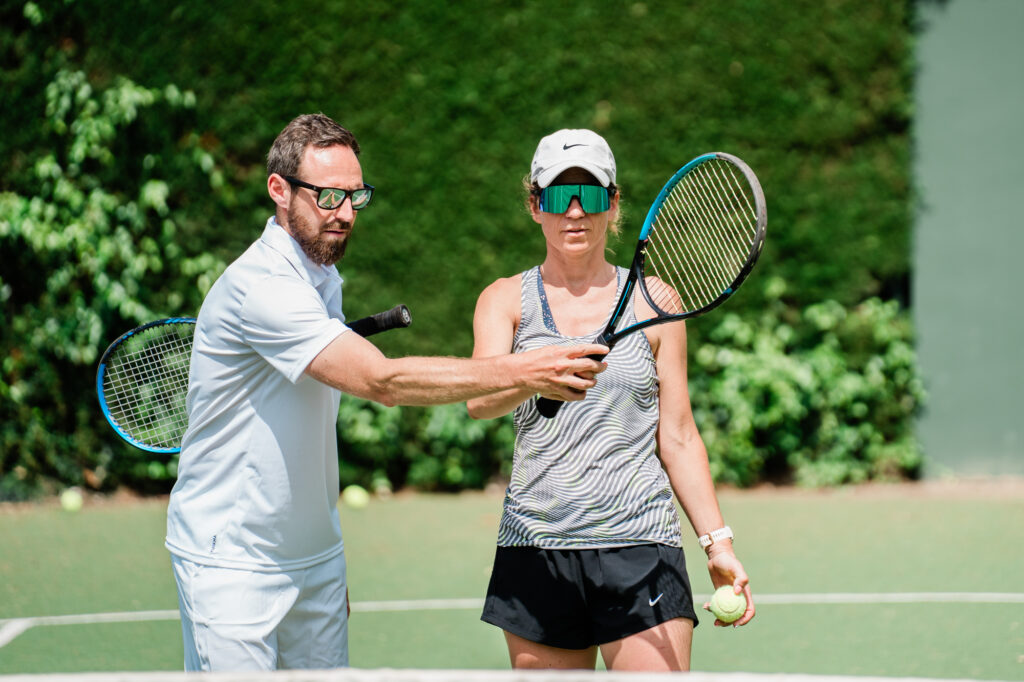
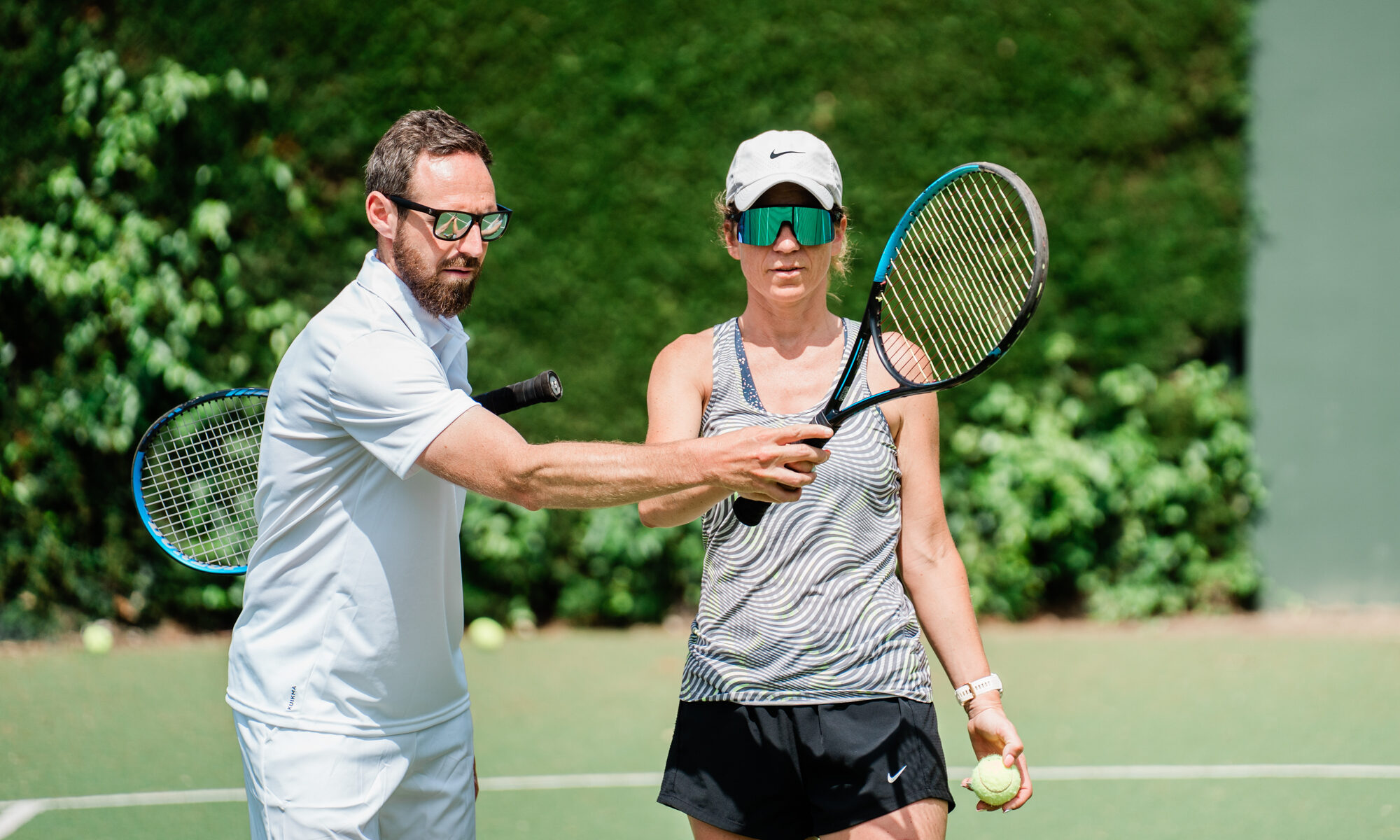
Physical execution, like the racket grip shown here, is only one part of the overall technical process.
Tennis Technique in 4 Steps
To break it down crystal-clearly, technique on a tennis court unfolds like this:
1. An Environmental Problem
What is the challenging situation I find myself in?
- Example 1: I am serving.
- Example 2: I am returning and I receive a powerful, high topspin ball to my backhand.
- Example 3: I receive a low, short slice shot while trying to recover my positioning.
2. A Playing Intention (The Tactical Goal)
What do I want to do with the ball? There are 3 levels of intention:
- Level 1 (The ball): Striking the center of the stringbed to send the ball at a specific speed, with a defined spin (flat, topspin, slice).
- Level 2 (The target): Controlling the pathway (height, depth, direction) and making the ball bounce in a precise way.
- Level 3 (The opponent): Putting the opponent in a hard position to force a weak reply or hitting it completely out of their reach.
3. The Internal Process
- A. Perception : Observing and Detecting clues (visual, auditory, kinesthetic) to read the ball’s trajectory.
- B. Decision : Selecting the most appropriate tactical response for the situation.
- C. Programming : Sending signals from the central nervous system to the relevant motor zones.
4. The Physical Execution
This is the visible output: the movement occurs with fluidity, relaxation, and efficiency (motor coordination).
In the Words of Champions and Coaches
Here are a few inspiring quotes that bring the true meaning back to the word technique:
“Decision-making learning is at the very heart of an activity like tennis. Seeing means first perceiving with the goal of deciding to trigger a specific, adapted action. In fact, technique integrates these different moments of information processing and must not be reduced to the visual mechanics used by the player.” – Gilles Bot (Tennis Coach at INSEP)
“Reducing technique to its most apparent components (motions) caused educators for decades to fall prey to the myth of the ideal physical form.” – Goirand
“My coach wants every shots have an intention.” – Gaël Monfils
“Nadal’s forehand technique was, above all, a response to a problem: that of not having enough strength against older opponents when he was a child.” – Jofre Porta (Former coach of Rafael Nadal)
Conclusion: The Tennis Propulse Vision
To conclude, I believe Toni Nadal’s words are the most striking:
“But what is technique? Is it hitting the ball with a beautiful motion? No. For me, technique is putting the ball wherever you want, with any given shot. I am not going to tell a player: you must hit the ball this way or that way, but rather: it doesn’t matter how you do it, just send the ball here, at this speed, with this spin.”
These words serve as an absolute benchmark in my daily coaching approach at Tennis Propulse.
To all passionate players and coaches, I highly recommend reading Harry Gehm’s book once again. It offers concrete drills to apply this exact philosophy out on the court.

Have a tactic objective into each shot to reach your full potential.
To finish, I invite you to try a quick mental and physical test designed to make you think, taken from the book The Inner Athlete by Dan Millman:
The Paper Ball Toss Test:
- Take a piece of scrap paper and crumple it into a ball.
- Place a trash can like a basket at any distance you like.
- Try to toss the paper ball into the basket. Challenge yourself by varying the distances.
- Have fun with it. Observe how your body naturally adjusts to the target (the intention) rather than focusing on the mechanics of the throw… then come share your thoughts with me!
See you soon on the tennis courts of the French Riviera—directly at your private villa or at our partner clubs (Cannes, Antibes, Vence, Nice, …).
Maxime Duchesne