
When we are looking the best tennis players in the world, we can note they are doing something very personnal : the routine between points.
This routine isn’t here for nothing. It helps to optimize the performance for the next point, to increase the chances to win the next point. More, it permites to manage his emotions, to recover, to be focus, to learn from each point et to start the next point with a clearest goal of the game.
Too often, players stay locked on the last point : a easy mistake, a break point missed, an umpire decision or reverse a great point too emotionnal who push the player out to the match !
Then, the goal of the routine is simple : to accept the last point doesn’t matter his result, to switch his mind to the next point and to take the best conditions to play as well as possible the next point.
Here, I share you the 5 steps i’m teaching to my players.
The method in 5 steps
Release → Correct → Switch → Plan → Play
Step 1 : Release
This phase is certainly the most important and unfortunatly some players don’t dare to do it…
The goal of this step is to express the useful emotions after the last point. It can be the joy, the disappointment, the anger, the frustration, the surprise, the relief or the shame, it’s important to let it out.
You could for example :
- Grip the fist after an amazing point.
- Scream because you are disapointed about what you did.
- Blow the frustration.
- Call a big : « Allez ! », « Vamos ! », « Come On ! » after an important point.
The key is to don’t keep inside yourself your emotions but to express them during some seconds to don’t lock them in your mind and body for the next points.
An emotion expressed is an emotion doesn’t stay closed in yourself that can become a emotionnal bowl paralyzing and anxiety-inducing.
My personnal experience about this topic :
When I was young, I was “forbidden,” or rather “scolded,” when I expressed my emotions. Depending on my eduction, my culture, and my sport environment (coaches, parents, etc.), expressing anger or joy after a point was frowned upon. Shouting “VAMOS!” after a winning point was considered a « bad », « exaggerated » attitude. My coach told me : « Calm down ».
As a result, I kept all those emotions bottled up inside.
Looking back, this didn’t help me. It created an inner trouble that affected my stress, eczema, anxiety, and even my tennis game. Of course, that’s not the only reason, but it certainly contributed.
This brings me to another topic we’ll discuss another time: the importance of self-esteem development from a young age. A young person who doesn’t allow themselves to be, say, or do what they feel is right for them, but instead acts according to others, risks suffering the consequences as an adult.
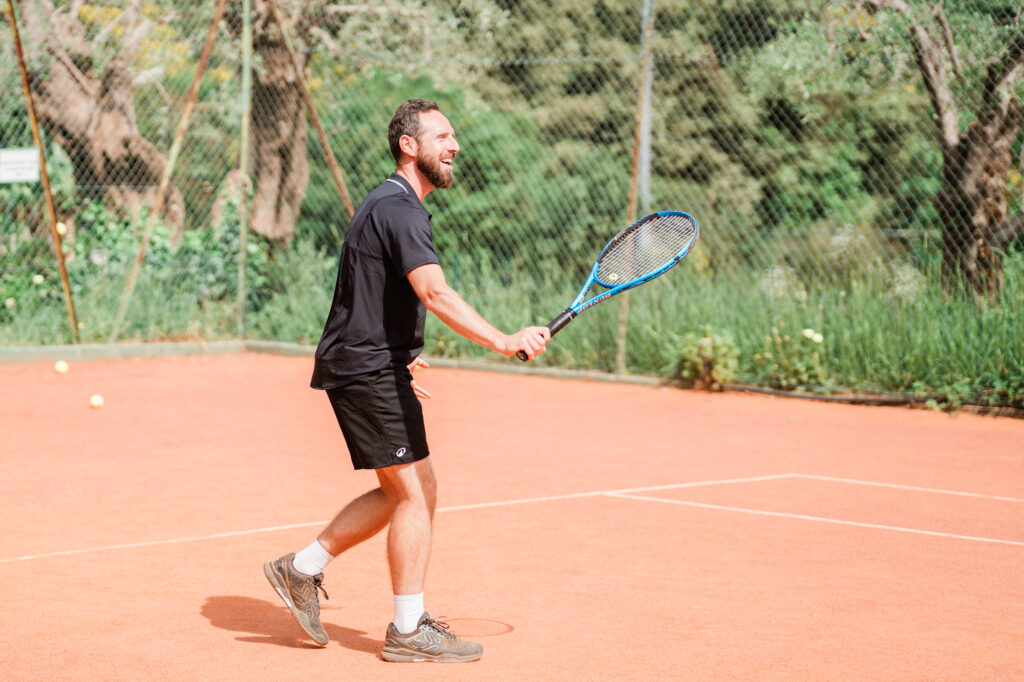
Smiling even after a mistake is one of the best mental strategies to perform in tennis.
Step 2 : Correct
Right after, or even during, this emotional release phase, the goal is to learn from the previous point.
Quickly ask yourself a few questions:
- What did I do well?
- What did I do wrong?
- What do I need to adjust?
- What should I keep doing?
- If I could replay this point, what would I do differently?
Note that this analysis must be extremely quick.
All these questions take less than a second.
The goal is not to replay the point shot by shot, but simply to learn from it.
It’s an instinctive phase based on your feelings and experience.
A little tip I really like:
- Case 1) Repeat the movement of the shot you just missed, visualizing yourself succeeding.
- Case 2) Conversely, if you’ve just pulled off a great feat, take half a second to visualize it again. This helps the brain remember successes, which is good for confidence and self-esteem.
Step 3 : Switch
This is the transition between la last point and the next point.
So, after expressing your emotions and retaining the important information, it’s time to bring your emotional level, heart rate, and physical and mental arousal back down.
Several tools can be used to do this:
- Take a deep breath followed by a slow exhale.
- Walk to the back of the court.
- Turn your back to the court for a few moments.
- Get your towel and dry yourself.
- Breathe calmly.
- Close your eyes for a few seconds.
- Relax physically.
- Shake yourself gently.
- Check and adjust the strings on your racket.
- Use positive self-talk.
- Adopt positive body language positive.
This step is essential because it allows you to create a real break from the previous point.
The goal is to feel empty, calm, and ready to move forward.
I like to suggest to my players that at that moment, inside their minds, the sky is perfectly blue, the sun is shining, a pleasant light breeze is blowing, and the sea is calm before them. In short, the ideal place, the one where you feel good, serene, and happy.
Once this state is achieved, you are fully available and motivated to experience the next point with passion and determination.
Once this state is achieved, it’s time to reactivate.
Some example of activations :
Through words:
-
- “Come on!”
- “Let’s go!”
- “Vamos!”
Bodywork:
-
- Bounce, Jump
- Shake your body
- Take one or more explosive steps
- Tap a part of your body
- Adopt a dynamic and engaged posture
It is with this commitment that I move towards the baseline to serve or to take my return position.
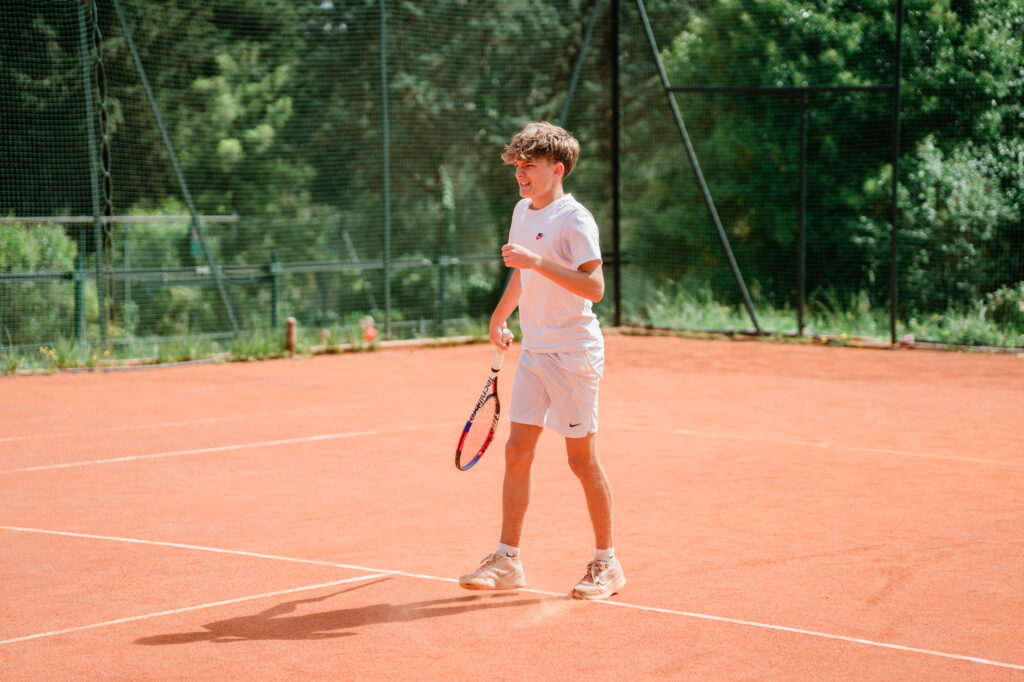
Whether the point is won or lost, dwelling on the past won’t change anything. Move on.
Step 4: Plan
Once you’ve calmed down and refocused, it’s time to prepare for the next point as you reach your serving or return position.
Take a relaxed position and ask yourself the right questions:
-
-
- What am I going to do on the next point?
- Where am I going to serve?
- Where am I going to return?
- What will my first shot be after the serve?
- What is the score?
- What strategy am I going to use to win this point?
-
Depending on the situation, your intention may be different:
-
-
- Win the point quickly in 1, 2, or 3 shots.
- Build up the rally.
- Force the opponent to play an extra shot.
- Use a serve-and-volley.
- Exploit an opponent’s weakness.
-
Once you’ve made your choice, confirm it with a word, a nod, or a body language gesture.
If you still have doubts, take a few more seconds and adjust your plan.
Only move on to the next phase when you are completely confident in your tactical choice.
Step 5: Play
Once you’ve made your decision, the pre-serve or pre-return routine begins.
Each player has their own routine.
Rafael Nadal is certainly the most famous example with all his pre-serve habits (that you know i’m sure).
Novak Djokovic also used to bounce the ball many times before certain serves (And that’s why the maximum time allowed between points has been set at 20 seconds).
These routines may seem trivial, but they all have the same goal: to prepare the body and mind for action.
Some common elements include :
-
-
- Bounce the ball and listen the bounce.
- Breathe slowly.
- Relax physically.
- Move slightly to stay dynamic.
- Find a comfortable position.
- Be aware of your stance and your body.
- Watch the ball.
- Visualize your planned shot one last time: zone, trajectory, spin, height…
- Go for it with an internal talking : “Go!”
-
Once this preparation is complete, there’s only one thing left to do:
Play the point.
Conclusion
A good routine between points doesn’t guarantee you’ll win every match.
However, it significantly increases your chances of performing well, staying focused, managing your emotions, and making better decisions throughout the match.
More you practice this routine in training, more it will become automatic in matches.
Before finishing this article, remember that routines are something natural and often unconscious. The more you listen to your body and mind, the better you’ll understand what truly works for you and what doesn’t. Trust your instincts, and allow your natural senses to guide you.
To finish, remember these 5 steps:
Release → Correct → Switch → Plan → Play
Point by point. Match by match.
Thank you for this post !
Really enjoyed the way each step has a clear purpose. Simple, practical and effective!
Hi Sabine, thanks a lot !